
Project controls leaders don’t usually struggle with knowing what good looks like. The struggle is getting an organization to consistently do it across projects, teams, contractors, and leadership priorities that change quarter to quarter.
That’s why Organizational Change Management (OCM) matters so much in project controls. New scheduling standards, cost controls processes, risk frameworks, or tools like Primavera P6 and Power BI can look great on paper. But, without a deliberate people-centric change approach, they often become “the new template nobody uses,” “the dashboard people don’t trust,” or “the process that slows the job down.”
This post is a practical look at people change management through a project controls lens: what makes it different, what typically goes wrong, and how organizations can build project controls capability that actually sticks.
Why project controls organizational change is uniquely hard
Project controls sits at the intersection of systems, people, and pressure.
- Systems: Scheduling tools, cost systems, document controls, reporting platforms, ERP integrations.
- People: Planners, cost engineers, project managers, superintendents, executives, owners.
- Pressure: Real deadlines, real money, and real consequences when the plan isn’t reliable.
When you introduce change here (new processes, new governance, new tools), you’re not just asking people to learn something new. You’re asking them to change how they make decisions under stress.
And there’s a common trap: organizations treat project controls transformation as a technical implementation (“roll out the tool,” “publish the procedure,” “train the users”). But the real work is behavioral: alignment, adoption, accountability, and trust.
The hidden cost of “process-first” rollouts
Most project controls changes fail quietly.
Not because the process is wrong, but because the rollout ignores the reality of the jobsite and the project environment. A few patterns show up again and again:
- Standards are created without field input. The result is a process that makes sense in a boardroom but creates friction in execution.
- Tools are implemented before decisions are clarified. Teams get dashboards but no agreement on what actions the data should drive.
- Training is treated as the finish line. People attend a session, then go back to old habits because incentives and expectations didn’t change.
- Governance is introduced without support. Reviews become “gotcha” meetings instead of coaching moments.
The cost isn’t just inefficiency. It’s a loss of confidence in project controls itself. When teams don’t trust the schedule, cost forecast, or progress metrics, they stop using them to lead.
What good organizational change management looks like in project controls
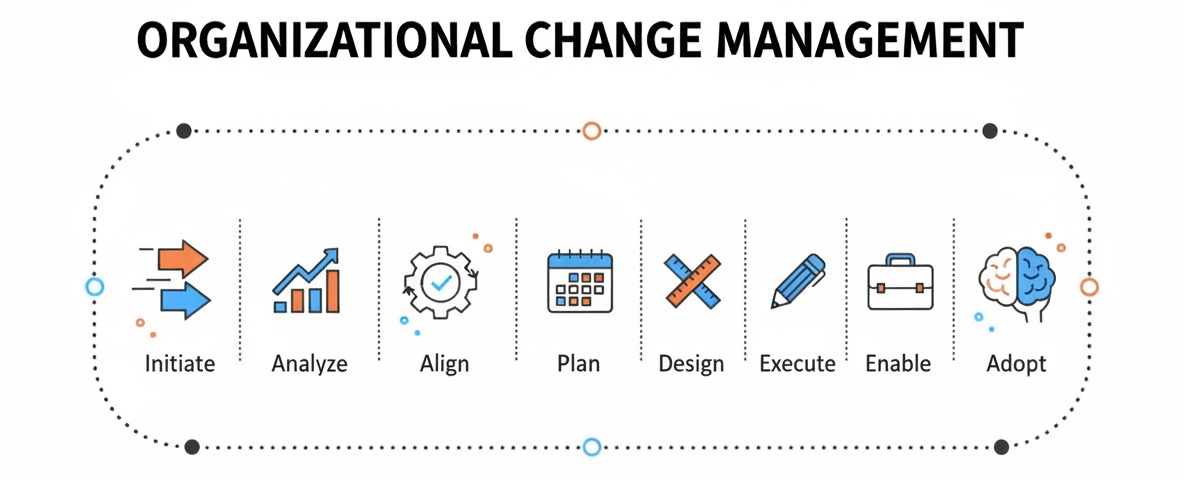
OCM is often misunderstood as “communications and training.” Those are important, but in project controls the organizational change has to be designed around how work actually flows.
Here’s what effective OCM typically includes.
1) Start with outcomes, not artifacts
A new WBS template isn’t an outcome. A new schedule format isn’t an outcome. Even a new tool isn’t an outcome.
Outcomes sound like:
- “We can forecast completion dates with confidence.”
- “We can explain variance in a way leadership trusts.”
- “We can identify schedule risk early enough to act.”
- “We have consistent progress measurement across projects.”
When outcomes are clear, processes and tools can be designed to support decisions – not just documentation.
2) Map the decision chain
Project controls exists to support decisions. So before you redesign processes, get clear on:
- Who needs what information?
- When do they need it?
- What decision will they make with it?
- What happens if they don’t trust it?
This is where many transformations unlock value. If you can align reporting to the decisions that matter (and remove reporting that doesn’t), adoption rises quickly.
3) Build credibility through quick wins
In project controls, trust is earned.
Instead of trying to transform everything at once, pick a few high-impact, visible wins:
- A schedule quality review that reduces rework and improves logic reliability
- A progress measurement approach that makes updates faster and more consistent
- A forecasting cadence that clarifies ownership and reduces surprises
Quick wins do two things: they prove the change is practical, and they create internal champions.
4) Design for the project environment (not the org chart)
Projects are temporary organizations. People rotate. Contractors change. Priorities shift.
So organizational change management has to account for:
- Onboarding and turnover
- Multiple stakeholders with different incentives
- Varying maturity across projects
- Different contract types and reporting requirements
The goal is to create a “minimum viable standard” that can scale across projects, plus a maturity path for teams that are ready to go deeper.
5) Make adoption measurable
If you can’t measure adoption, you can’t manage it.
In project controls, adoption measures might include:
- Schedule health metrics (logic, constraints, float paths, update quality)
- Forecast accuracy over time
- Timeliness of updates and reviews
- Variance explanations that tie to actionable drivers
- Consistency of progress measurement
This isn’t about policing teams. It’s about creating visibility so leaders can coach, support, and reinforce the behaviors that make controls effective.
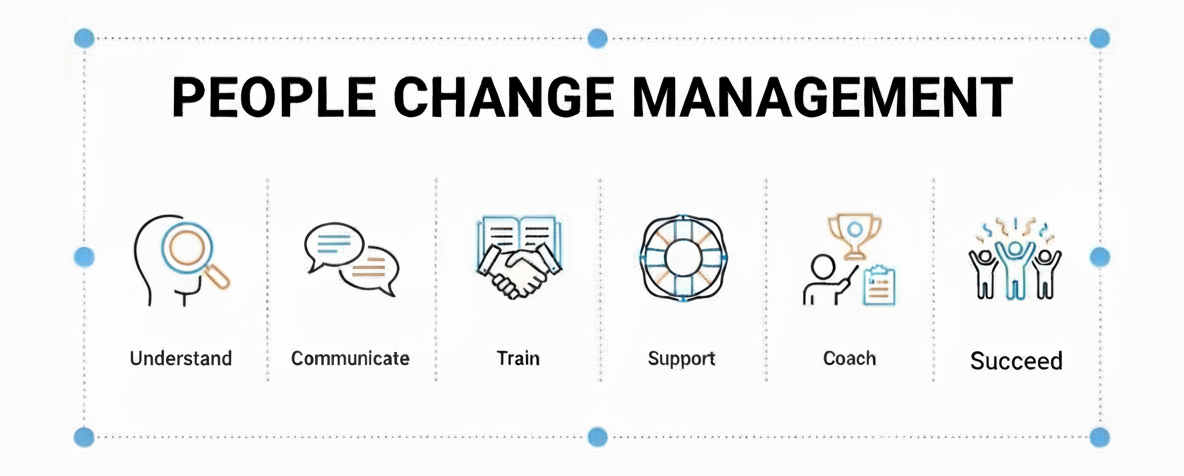
The three levels of change: people, process, and system
Most organizations focus on one level at a time. The best transformations connect all three.
People: capability and confidence
Project controls capability isn’t just technical skill. It’s judgment.
People need:
- The “why” behind the standard
- The confidence to apply it in messy real-world situations
- A shared language across planning, cost, risk, and project management
Process: clarity and repeatability
Good processes make it easier to do the right thing than the wrong thing.
That means:
- Clear definitions (what does “percent complete” mean here?)
- Clear roles (who owns the forecast? who approves changes?)
- Clear cadence (when do reviews happen? what decisions come out of them?)
System: enabling, not complicating
Systems should reduce friction.
But if the system is rolled out without process clarity, it becomes a source of confusion. If the process is rolled out without system support, it becomes manual and painful.
The sweet spot is when systems reinforce the process and make compliance natural.
A practical starting point for organizations
If you’re thinking about improving project controls maturity, start with a few questions:
- Where is trust breaking down today? (Leadership? Schedule? Forecast? Progress? Reporting?)
- What decisions are being made without reliable controls?
- What’s the smallest change that would create a visible improvement in the next 30–60 days?
- What behaviors need to change? (not just what templates need to change)
Those answers will point you toward a change strategy that’s grounded in reality.
Why we’re talking about this now
At Plan Academy, we’ve spent years helping individuals and organizations build project controls capabilities. As we expand our consulting services, we’re leaning into a bigger challenge we see across the industry: enabling organizations to have effective project controls beyond implementing tools or publishing standards.
That includes strategic consulting and organizational change management for project controls processes, systems, and capability. Because the real goal isn’t “a new process.” The goal is a team that can plan, forecast, communicate, and execute with confidence and trust.
If your organization is planning a project controls transformation (or you’ve tried one before and it didn’t stick) we’d love to compare notes. The conversation alone often surfaces the real constraints and the fastest path to meaningful improvement.

