When we talk about performing forensic delay analysis techniques or methodology, we get this question in our course all the time: what are the best sources? Where do I go for the instruction manual? Like, where is it? I know you guys have heard about performing time impact analyses or the Windows analysis on a project.
And you can definitely go on the internet and probably find some people who provide direction about it. But the question is: what are the main sources, the sources that would maybe stand up in court? So I want to talk about this a little bit. We have our course, Forensic Schedule Delay Analysis course coming up in a couple of weeks and this is the best time to talk about these standard practices.
Give this video a watch:
Transcript
This is a really great topic and a good opportunity for me to kind of dismiss or not dismiss but demystify this a little bit. So there are three organizations that you want to be aware of. We’ll talk about them briefly here in this video.
So the first one actually you can probably find something online but it’s the Society of Construction Law.
They’re more based in the UK so if you are a project controller looking to figure out how to do delay claims or whatnot, maybe you’re based in Europe or based in the UK, the Society for Construction Law, they’re a really great source for techniques and methodologies that that are accepted over there in their judicial system. So I would definitely start there. Now it doesn’t mean these other sources are no good. They’re also really good, but you also want to think about if you ever have to challenge any of these in a legal proceeding, where do you go and how do you do that? So you want to make sure that you’re using sources that are known and acceptable in your jurisdiction.
So let’s talk about here in North America which ones we would go to. So let’s start with this one. This is the ASCE, the American Society of Civil Engineers.
They’re very well known. They have been providing guidance in forensic delay analysis for quite some time, and they have some methodologies that are very resonant and acceptable. Here’s an example, one of their popular documents, 67-17, the schedule delay analysis document. Now you can go through it and there might be other documents as well. I’m not part of the society, I don’t know. I don’t have access to all their information, but I know this one is definitely out there. So you could go through it.
I think it’s not as complete as my final source, but it definitely covers some of the important parts that you would want to question in putting together a forensic delay analysis. So here we’ve got some topics around critical path, float, acceleration, changing schedules, etc.
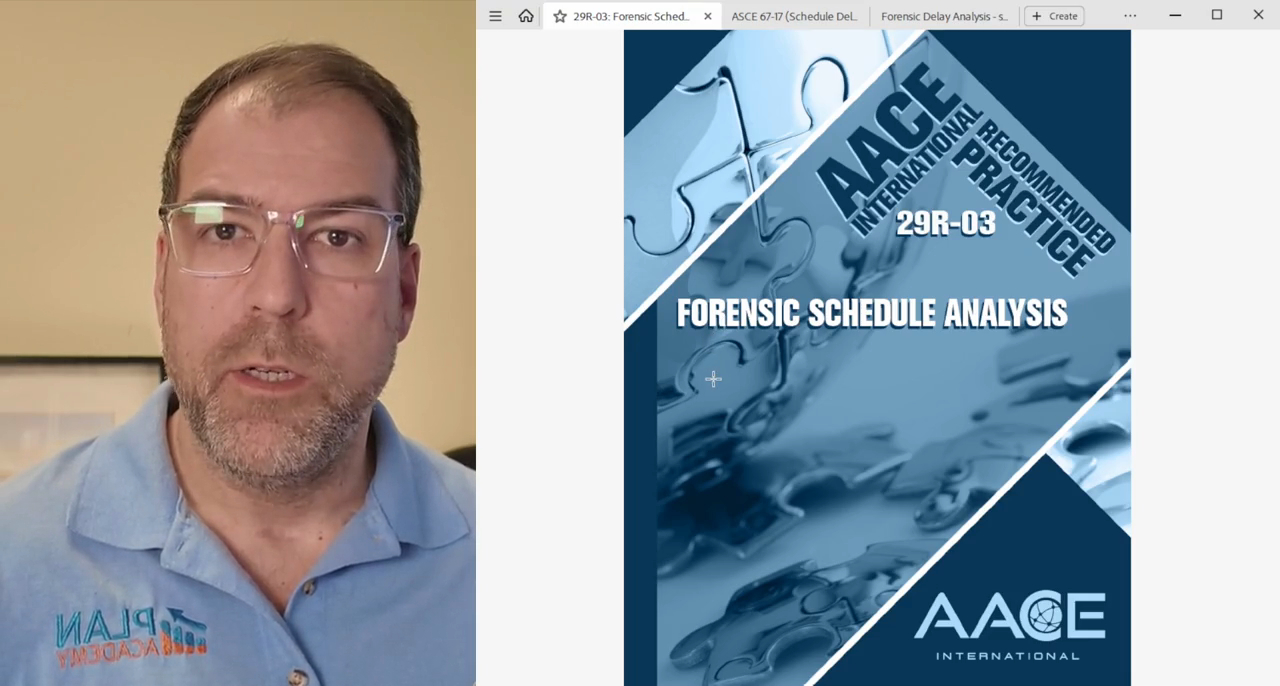
And lastly, I would probably point you to the AACE (again I’m a little biased because I am a member of the AACE and have been for a long time), but this is a well known document the 29R-03 Forensic Schedule Analysis Delay document provided by the AACE.
AACE (Association for the Advancement of Cost Engineering) is an international organization and they provide lots of documents. They have the whole cost management process that you can check out. But this one definitely is an in-depth document that covers really all the aspects and all the forensic delay methodologies that you would be interested in.
Not only that, but there’s a really great taxonomy and, kind of a hierarchy of the different methodologies.
And that’s important – there are different methodologies and they apply to different situations. They have a really great hierarchy that explains how some of that comes about and how to use those methodologies. This document is also very complete – it’s a 130 page document.
It’s peer reviewed. It’s definitely the source. So some of you guys have heard of the MIPS 3.1, 3.2, 3.4. These are the methodologies that anybody in North America who is a forensic delay analysis, let’s say they’re a claim agent, would be using this document a lot to help put those analyses together and figure it out. So that’s a little bit of of demystifying where some of this information comes from.
I wanted to bring it to you today because our Forensic Schedule Delay Analysis course is starting in January in a couple of weeks. You should check it out. It is a really well received course that we run, a couple times a year. It’s taught by not me because I’m not the expert, but we brought in the expert Tyler Konter PE, PSP, CCP, from Point Construction Advisory Group and he does this for a living. This is all he does. He goes to litigations, he teaches, and he performs scheduled delay analysis.
Having trouble getting the good words out today. So it is a great course to help you understand where all this works. And it’s also not specific to software. We do touch on P6 quite a bit, but we’re not going to hold you to a software, package in this course.
So check out the link, sign up. We’d love to see you. We’d love to have you. Hopefully this was informational.